Dehydrated Vegetable Suppliers in India: A Buyer's Guide
Checked
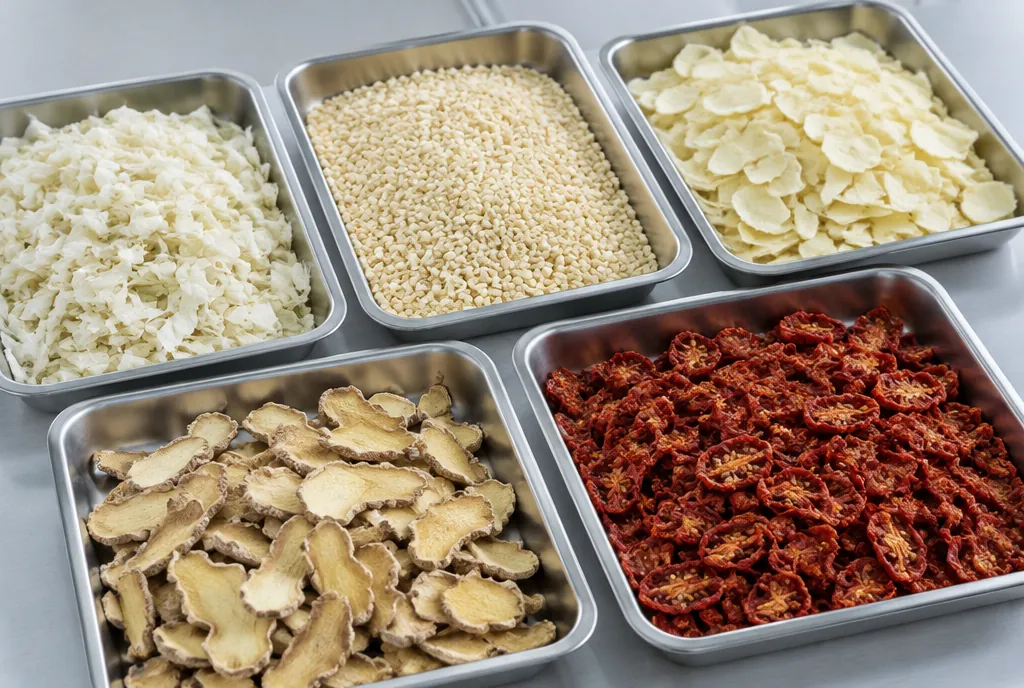
If you are searching for the best dehydrated vegetable suppliers in India, the useful question is which supplier can prove that every lot meets your specification. Start with the vegetable and form you need, write the specification down, approve a sealed sample, and ask for a certificate of analysis for each lot before the container leaves port. This guide shows you how to compare suppliers on those points, so you choose on evidence rather than on a list.
Which dehydrated vegetables does India supply at scale?
A dehydration industry follows its raw material. India grows large volumes of the vegetables that buyers most often want dried, so the first step is to match your product to a crop India produces in quantity.
The Department of Agriculture and Farmers Welfare's second advance estimates for 2025-26 put onion production at 307.37 lakh tonnes, potato at 598.89 lakh tonnes and tomato at 214.61 lakh tonnes. For garlic and ginger, the Spices Board's spice-wise area and production table gives advance figures for 2023-24 of 3,213,930 tonnes of garlic and 2,226,239 tonnes of fresh ginger.
Raw crop volume does not tell you how much is dried, but it does tell you where supply is deep. On the processing side, APEDA's processed vegetables page lists dehydrated garlic powder, dehydrated garlic flakes, dried garlic, dried potatoes and dehydrated peas among the products it tracks. The same page reports processed vegetable exports of 7,26,874.82 tonnes worth USD 932.19 million in 2025-26, from DGCIS data. That category also covers preserved, frozen and canned items, so read it as the size of the wider trade, not of dried vegetables alone.
The table below also shows where Poorti Mandalam LLP, a food house in Ahmedabad, publishes a range for each item.
| Vegetable | India's raw crop (source) | Forms buyers usually order | Poorti range page |
|---|---|---|---|
| Onion | 307.37 lakh tonnes, 2025-26 estimate (PIB) | Kibbled, chopped, minced, granules, powder, crispy fried, toasted | Dehydrated onion |
| Garlic | 3,213,930 tonnes, 2023-24 advance (Spices Board) | Flakes, cloves, chopped, minced, granules, powder | Dehydrated garlic |
| Ginger | 2,226,239 tonnes fresh, 2023-24 advance (Spices Board) | Dried slices, pieces, powder | Dried ginger |
| Potato | 598.89 lakh tonnes, 2025-26 estimate (PIB) | Flakes, flour | Potato flakes and flour |
| Tomato | 214.61 lakh tonnes, 2025-26 estimate (PIB) | Flakes, powder, roasted pulp | Fire-roasted pulps |
| Carrot, beetroot | Not separately stated in these sources | Powder | Vegetable and fruit powders |
For mainstream items such as onion and garlic, ask two or three suppliers for samples so you have a real basis for comparison. For narrower items such as beetroot powder or roasted pulps, expect fewer sources and plan more time for sampling.
How was it dried, and why does that matter to you?
Two lots of onion flakes can look alike in a photograph and behave very differently in your kitchen or line. Much of that difference comes from how the vegetable was prepared and dried. Ask the supplier to name the method for the exact product being quoted, and to confirm that the sample was made the same way as the shipment will be.
Hot-air drying
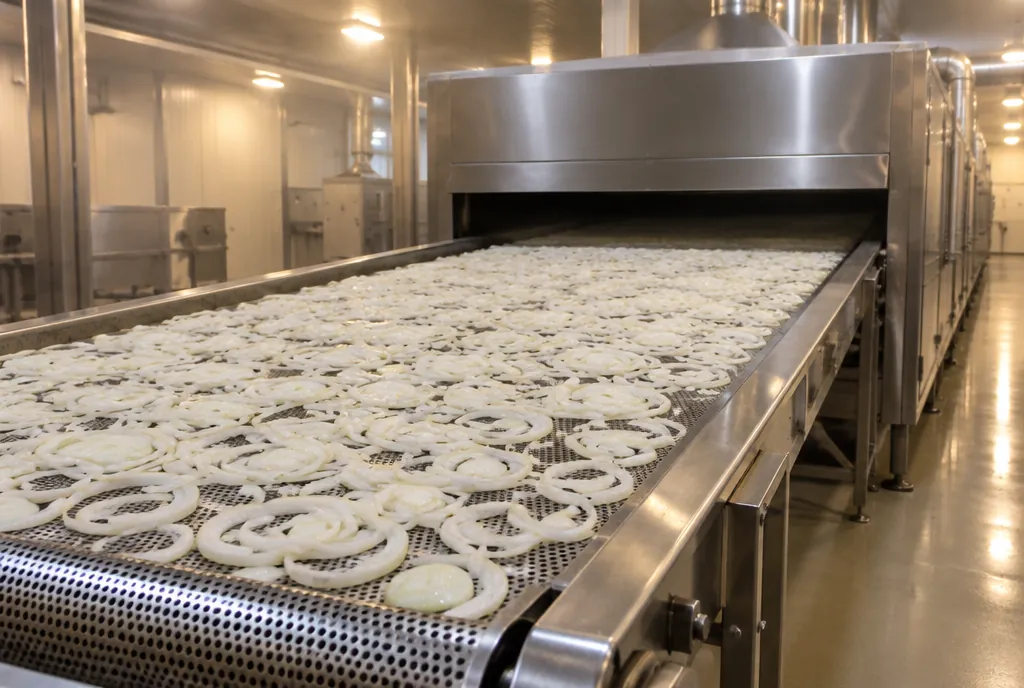
Hot-air drying on belts, trays or in cabinets moves heated air over cut vegetables until enough water has gone for the product to keep. The risk is heat damage: scorching, browning and poor rehydration if the temperature or time is wrong. India's own standard for dehydrated vegetables under FSSAI regulation 2.3.36 requires a uniform colour, free from discolouration due to scorching or enzymatic reaction, which gives you a fair reference point when you inspect a sample.
Freeze-drying
Freeze-drying removes water from frozen product under vacuum at low temperature. It keeps shape, colour and flavour better, which matters for visible inclusions in premium soups and ready meals. A 2023 review in the journal Foods notes that freeze-drying uses roughly four to ten times more energy than hot-air drying and costs more. Ask for it only where your product needs it. For a seasoning blend that cooks for an hour, hot-air dried onion is usually the sensible choice.
Pre-treatment: blanching and sulphiting
Some vegetables are blanched before drying to stop enzyme activity. An FAO training manual on post-harvest handling and processing explains that blanching is used for hard vegetables such as carrots, beans and peas, but not for soft ones such as tomatoes, onions and peppers. The same manual notes that sodium or potassium metabisulphite is used to keep colour in dried fruit and vegetables.
That second point matters if you sell into Europe. Under EU Regulation 1169/2011, sulphur dioxide and sulphites above 10 mg/kg, expressed as total sulphur dioxide, must be declared as an allergen. Ask in writing whether any sulphite was used, and if so, ask for the residual sulphur dioxide result on each certificate.
| Method | What it does to the product | What to ask the supplier |
|---|---|---|
| Hot-air (belt, tray, cabinet) | Economical for bulk; colour and rehydration depend on temperature control | Dryer type, final moisture target, how scorched pieces are removed |
| Freeze-drying | Keeps shape and colour; higher energy and cost | Whether your use needs it, and the moisture and packing that keep it crisp |
| Sun or open-air drying | Exposed to dust, insects and weather | Whether any part of the lot was sun-dried, and how foreign matter is controlled |
| Blanching or sulphiting before drying | Protects colour; sulphite may need declaring | Which pre-treatment was used, and the residual sulphur dioxide result |
What specification should you ask for in each form?
A specification is the document both sides sign before money moves. It turns "good quality" into numbers a laboratory can check. Without it, a dispute after arrival becomes your word against the supplier's.
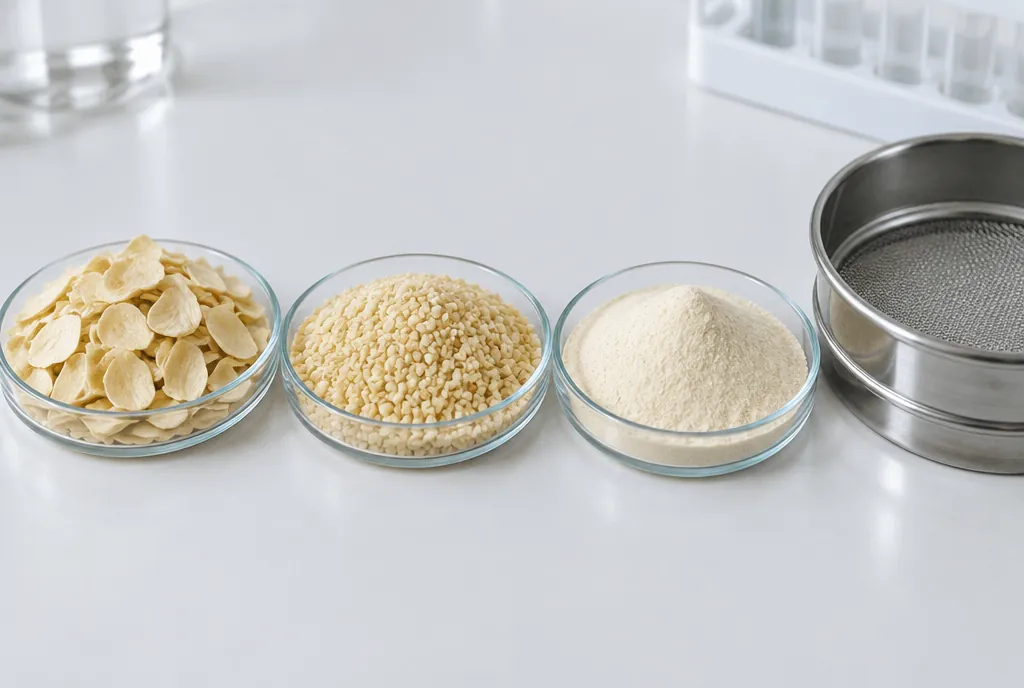
The form you buy decides which numbers matter most. Flakes and kibbled pieces are defined by size range and colour. Minced and granules are defined by particle range. Powders are defined by mesh, flow and moisture, because a powder that picks up water cakes in the bag.
| Form | How size is defined | Poorti's published ranges | Checks that matter most |
|---|---|---|---|
| Kibbled, flakes, cloves | Piece size in mm, with a tolerance for fines | Onion kibbled 8-20 mm; garlic flakes and cloves | Colour, scorched pieces, fines, foreign matter |
| Chopped and minced | Particle range in mm | Onion minced 1-3 mm; garlic chopped and minced 1-3 mm | Size distribution, colour, moisture |
| Granules | Particle range in mm or mesh | Garlic granules 0.1-1.0 mm; onion granules | Size distribution, flow, moisture |
| Powder | Mesh (share passing a stated sieve) | Onion powder 80-100 mesh; garlic powder 100-120 mesh | Mesh, moisture, caking, microbiology |
| Potato flakes and flour | Share passing a stated sieve | Potato flakes 100% through 1.7 mm | Moisture, colour, bulk density for your line |
India sets a floor for domestic sale. The FSSAI standard for dehydrated vegetables sets moisture at not more than 8.0% for dehydrated vegetables and 5.0% for vegetable powders, acid insoluble ash at not more than 0.5%, and a negative peroxidase test. It also says powders must be free flowing and free from agglomerates. Your contract can and usually should be tighter, built around your own use and your country's rules.
For onion and garlic there are also international references. ISO publishes ISO 5559 for dehydrated onion and ISO 5560 for dehydrated garlic. You can write your own sheet and still borrow the test methods these standards name, so both sides measure the same way.
A workable specification sheet covers these points:
- Product, variety and colour (for onion, white, red or pink).
- Form and size range, with the tolerance for oversize and fines.
- Moisture limit, and total and acid insoluble ash.
- Colour standard, ideally matched against the approved sample.
- Microbiological limits: total plate count, yeast and mould, coliforms, E. coli and Salmonella.
- Pesticide residue limits for your destination market.
- Residual sulphur dioxide, if any sulphite is used.
- Foreign matter, and any metal detection or sieving step you require.
- Packing, net weight, lot marking and shelf life.
For the grade terms used for onion and garlic, see the house guides to dehydrated onion grades and dehydrated garlic grades.
Which tests matter, and what should a certificate of analysis show?
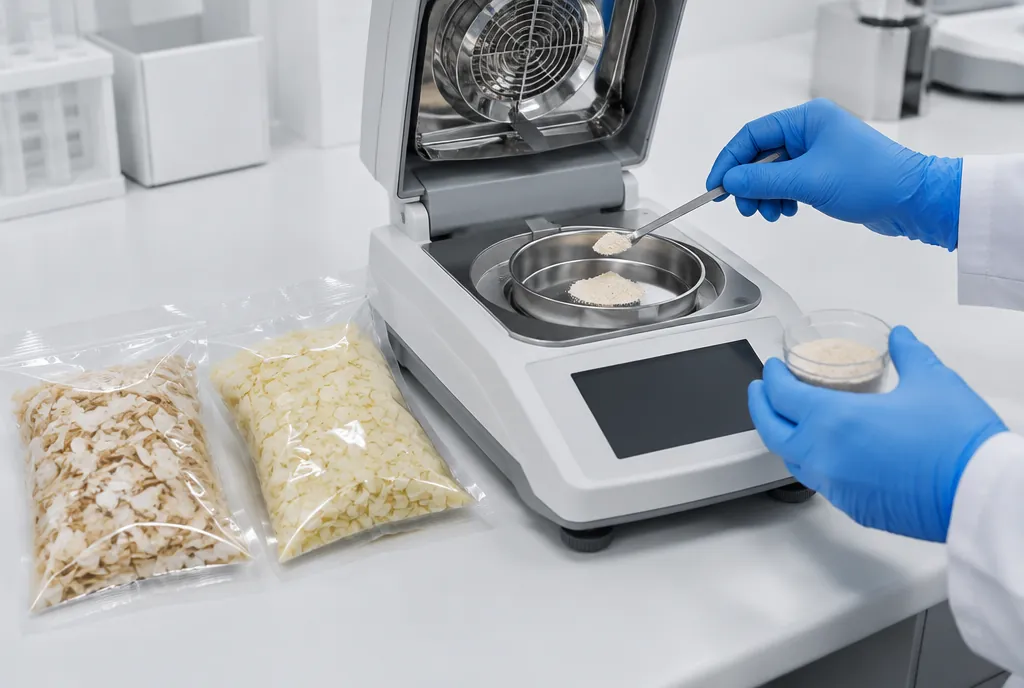
A certificate of analysis is only as good as the link between the paper and the bags. Before you rely on one, check that it carries the same lot number printed on the sacks or cartons, the production or packing date, the laboratory's name, the test methods and each result next to its limit.
Ask where the tests were done. A supplier's in-house laboratory is useful for daily control. For results you will rely on in a dispute, ask for an outside laboratory accredited for those tests. In India, the National Accreditation Board for Testing and Calibration Laboratories (NABL) accredits laboratories, and you can check whether a laboratory's accreditation covers the specific test you need. FSSAI also publishes a manual of methods for analysing fruit and vegetable products, which is a sound reference when you agree how moisture, ash and other values are measured.
The tests to agree for most dehydrated vegetables fall into four groups:
- Physical: size or mesh, colour, foreign matter, fines.
- Chemical: moisture, total ash, acid insoluble ash, residual sulphur dioxide where relevant.
- Microbiological: total plate count, yeast and mould, coliforms, E. coli, Salmonella.
- Residues: pesticide residues against your market's limits. For Europe, check limits in the EU pesticides database.
Decide in advance which results are on every certificate and which are tested at agreed intervals. Pesticide panels cost more, so you may choose to run them on the first lots and then at agreed intervals. Microbiology and moisture belong on every lot. Ask for one certificate for every lot, not one per shipment, because a container can carry several lots.
Keep a retained sample from each lot on your side as well. If a later complaint arises, a sealed retained sample lets you test the same material the certificate describes.
How should sample approval work?
Sample approval is where most later disputes are won or lost. A sample that was hand-picked from a good batch tells you little about the container. A sample that is sealed, labelled and kept by both sides becomes the reference the shipment is judged against.
Run it in four steps:
- Ask for a representative sample of the exact grade, form and size you will order, with its own lot number and a certificate of analysis.
- Test it in your own process. Rehydrate it, cook it, blend it or run it through your line. A powder that looks right may not flow through your dosing equipment.
- Approve it in writing against the specification, noting the lot number and any comments on colour or size.
- Seal and keep a counter-sample. The supplier keeps one, you keep one. The shipment is then checked against this sealed reference.
If the supplier changes the raw material season, the dryer or the size range, ask for a fresh sample. One approval should not stand in for a different product, and a garlic powder approval does not carry over to garlic granules.
Which papers should an Indian supplier hold?
Before you discuss price, confirm the supplier can legally export food. In India that usually means an Importer-Exporter Code from DGFT, a food business licence you can check on FSSAI's FoSCoS portal, and registration with APEDA, which issues the registration-cum-membership certificate for exporters of scheduled products.
Match the legal name and address on each document with the name on the quotation and the invoice. If the names differ, ask why. A trader who buys from a processor can be a perfectly good supplier, but you should know which factory makes your product and whose name will be on the shipping documents.
Your own country's rules sit on top of these. Food safety registration, import notices, labelling and residue limits are set by the destination market. The house guide to importing food from India sets out the paperwork on both sides, step by step.
FOB, CIF or C&F: which shipping term suits you?
The shipping term decides who books the freight, who insures the cargo and where the risk passes from seller to buyer. Agree it before you compare prices, because an FOB price and a CIF price are not the same thing.
The International Chamber of Commerce explains that FOB is meant for sea or inland waterway transport, with risk passing once the goods are loaded on board the vessel at the port of shipment. Under CFR and CIF, the seller pays freight to the destination port, but risk still passes when the goods are on board at origin. CIF adds insurance arranged by the seller, which, subject to the contract, can be the limited cover of Institute Cargo Clauses (C). C&F is the older trade name for CFR.
| Term | Who books sea freight | Who insures the cargo | Where risk passes |
|---|---|---|---|
| FOB (Indian port) | You | You | On board the vessel at the Indian port |
| C&F or CFR (your port) | Supplier | You, if you want cover | On board the vessel at the Indian port |
| CIF (your port) | Supplier | Supplier, at the level the contract states | On board the vessel at the Indian port |
If you have a forwarder with good rates out of Gujarat, FOB gives you control of the booking. If you are new to buying from India, C&F or CIF lets the supplier handle the freight, but read the insurance clause under CIF and consider topping up the cover. Poorti quotes FOB Mundra, CIF or C&F.
Agree packing in the same document. State the bag or carton type, liner, net weight per pack, lot marking and whether you need pallets. As an example of how a published packing line reads, Poorti's potato flakes and flour ship in 20 kg sacks, 480 sacks or 9,600 kg per 20 ft container.
What are the red flags when you compare suppliers?
Most problems show up early, if you know what to look for. Treat any of these as a reason to slow down and ask more questions:
- No written specification. The supplier offers "export quality" but will not sign a sheet with numbers.
- Certificates without lot numbers. A certificate that cannot be tied to bags in your container proves little.
- The same certificate for every shipment. Identical results across months suggest a template, not a test.
- Vague answers on drying method or pre-treatment. The supplier cannot say how the product was dried or whether sulphite was used.
- A sample unlike the price. A premium sample paired with a price well below other quotes for the same grade deserves a closer look at the bulk lot.
- Names that do not match. The licence, the export registration and the invoice carry different company names with no explanation.
- Pressure to skip steps. A request to ship before sample approval, or to pay in full before any inspection.
- No retained samples. The supplier does not keep a counter-sample from each lot.
- Refusal of a factory visit or inspection. A supplier with nothing to hide will usually agree to an inspection before loading.
If you cannot visit India yourself, an inspection at the processing site before the container is sealed is the most direct check you can buy. The Verify factory inspection door exists for overseas buyers in exactly this position.
A checklist to use before you place the order
Use this list to compare two or three suppliers side by side. A supplier who cannot tick most of it is not ready for your order.
- Vegetable, variety, form and size range written down.
- Specification sheet signed by both sides, with moisture, ash, colour, microbiology, residues and packing.
- Drying method and any pre-treatment confirmed in writing.
- Residual sulphur dioxide declared, if sulphite is used.
- Representative sample received with its own lot number and certificate.
- Sample tested in your own process and approved in writing.
- Sealed counter-samples held by both sides.
- Laboratory and accreditation scope confirmed for the tests you rely on.
- Certificate of analysis agreed for every lot, tied to bag marking.
- IEC, FSSAI licence and APEDA registration checked against the supplier's legal name.
- Your own import, labelling and residue rules confirmed for the destination.
- Shipping term agreed (FOB, CFR or CIF), with port and insurance level stated.
- Packing, net weight, pallets and lot marking agreed.
- Pre-loading inspection arranged, or a clear reason why not.
Where does Poorti Mandalam LLP fit?
Poorti is a food house in Ahmedabad, not a manufacturer, and it owns no plant. The house works through a circle of farmers, processors, testing laboratories and logistics partners across India, and holds each of them to one standard.
For a buyer, that means the work in this guide is done on your behalf. Through the Source door, Poorti takes your specification, sources the product through its circle, sends a sealed sample for your approval, and ships with a certificate of analysis for every lot. The range covers dehydrated onion (white, red and pink, crispy fried and toasted), dehydrated garlic, dried ginger, potato flakes and flour, fire-roasted pulps, and carrot, beetroot and fruit powders, in private-label or neutral packing.
If you already have a supplier in India and only need eyes on the ground, the Verify inspection door covers a factory inspection for overseas buyers. If you are starting a brand rather than buying an ingredient, the Make door runs the six steps from brief to dispatch.
Questions people ask
How do I find dehydrated vegetable suppliers in India?
Start from your specification, not from a directory. Shortlist suppliers who can sign a written specification for your exact form, send a representative sample with a certificate, and show an FSSAI licence, an Importer-Exporter Code and APEDA registration in the same legal name. Then compare samples in your own process before you compare prices.
What moisture should dehydrated vegetables have?
India's FSSAI standard caps moisture at 8.0% for dehydrated vegetables and 5.0% for vegetable powders. Your contract can set a tighter limit to suit your use, packing and climate. Agree the test method as well as the number, so both laboratories measure the same way.
Is freeze-dried better than hot-air dried?
It keeps shape and colour better, but it uses far more energy and costs more. For seasonings, sauces and blends that are cooked, hot-air dried onion, garlic and potato usually do the job. Freeze-dried pieces make sense where the vegetable must look whole and fresh after rehydration.
Should every lot have a certificate of analysis?
Yes. A container can hold several lots, and each lot can differ. Ask for one certificate per lot, carrying the same lot number as the bags, with moisture and microbiology on every certificate and residue tests at agreed intervals.
What is the difference between flakes, granules and powder?
They are the same vegetable cut or milled to different sizes. Flakes and kibbled pieces are measured in millimetres, granules by a particle range, and powders by mesh. Each form behaves differently in mixing, flow and rehydration, so approve a sample of the exact form you will buy.
Which shipping term should a first-time buyer use?
A first-time buyer often finds C&F or CIF simpler, because the supplier books the freight. Remember that risk still passes once the goods are on board in India, so check the insurance level under CIF. If you already work with a forwarder, FOB gives you more control over the booking.
If you are comparing suppliers for dehydrated onion, garlic, ginger, potato or vegetable powders, send Poorti the product, the specification you buy to and your destination port at poorti.net/contact. If you are building a food brand of your own, start at poorti.net/make.
Buying from India?
Send the product, the specification you buy to and the destination port, and the house will come back to you.
Send an enquiry