Importing Food from India: A Buyer's Step-by-Step Guide
Checked
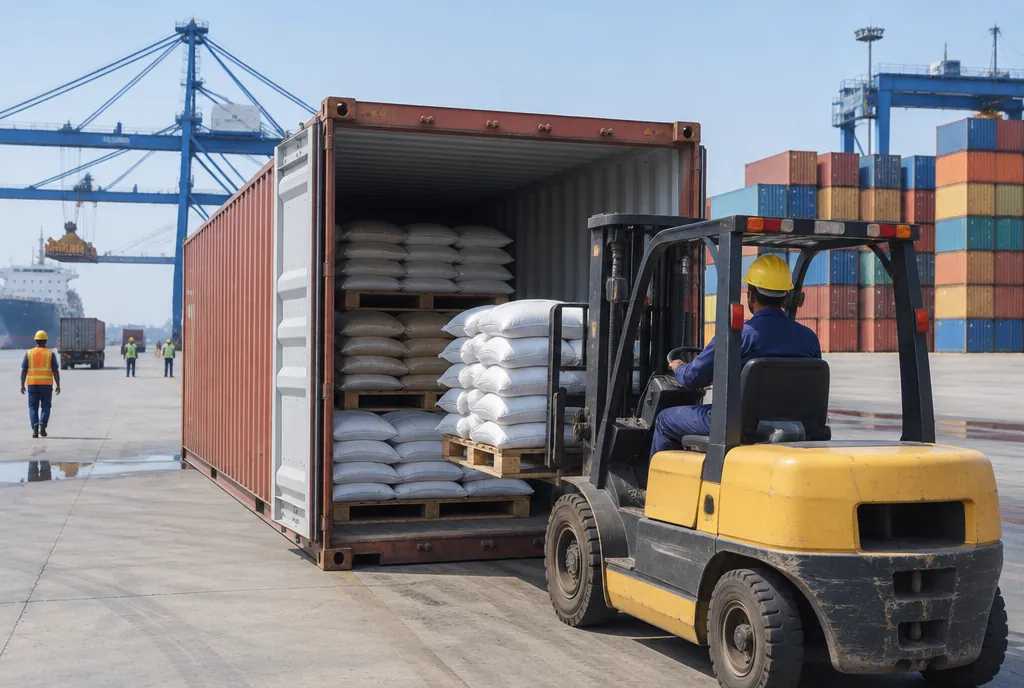
Importing food from India works when three things line up before the container is booked. The Indian exporter must be cleared to export, your own country's import rules must be met for that exact product, and the contract must fix the specification, the reference sample, the testing and the shipping term. Miss any one of the three and a sound product can still sit at the port.
This guide is for importers, food manufacturers and brand owners abroad who buy from India by the container. It sets out each check in the order you meet it, with the official source for every rule. It is written by Poorti Mandalam LLP, a food house in Ahmedabad that works through a circle of farmers, processors, manufacturers, testing laboratories and logistics partners across India.
Two sets of rules apply to every shipment
Most pages on this subject explain how to bring food into India, which is the opposite direction. If you are buying from India, two separate rulebooks apply to the same container.
- India's export side. The exporter needs its own registrations, and some shipments need certificates issued by Indian government bodies before the goods leave.
- Your import side. Your regulator decides what may enter, what must be declared in advance, what is checked at the border and what the label must say. In the markets covered below, much of the legal duty to get this right sits with you as the importer, not with the seller.
The two sides meet in the contract. It is the only place where you can make the exporter responsible for the parts of your import rules that depend on how the food is made, tested and packed.
Step 1: Check the exporter's Indian paperwork
Ask for these numbers before you discuss price. Each one can be checked against the issuing body.
Importer-Exporter Code (IEC)
India's Directorate General of Foreign Trade states that no export or import of goods may be made without an Importer-Exporter Code unless specifically exempted. The IEC now matches the firm's PAN but is issued separately. If a seller cannot give you an IEC, it cannot ship goods to you in its own name.
FSSAI licence
The Food Safety and Standards Authority of India says in its licensing FAQ that no FSSAI NOC is needed to export food, but the exporter must hold an FSSAI licence, and that export units apply for a Central licence. The same FAQ explains that manufacturers of food meant for export may follow the standards of the importing country, provided they do not sell those products in India without prior approval. That matters to you: it means the exporter can make to your specification and your legal limits rather than India's.
APEDA registration
The Agricultural and Processed Food Products Export Development Authority, under India's Ministry of Commerce and Industry, issues a Registration-cum-Membership Certificate (RCMC) to exporters of its scheduled products. Its circular on the process says exporters should apply for the RCMC after getting an IEC from DGFT, and that applications now run through the DGFT portal. Ask whether your product falls under APEDA's schedule and, if it does, for the RCMC number.
Certificates issued by the Export Inspection Council
The Export Inspection Council was set up under the Export (Quality Control and Inspection) Act, 1963. Its published functions include issuing health and authenticity certificates under various product schemes, and certificates of origin under preferential tariff schemes. If your country has a trade agreement with India that lowers duty, ask your customs broker which certificate of origin it expects.
Phytosanitary certificate
Plant products, including some dried vegetables and spices, may need a phytosanitary certificate from India's plant protection organisation. The Directorate of Plant Protection, Quarantine and Storage explains that India certifies exports in line with the International Plant Protection Convention, based on the importing country's phytosanitary requirements, and that exporters apply through the PQMS portal. Whether you need one depends on your country's rules for that product, not on India's.
Step 2: Learn your own country's import rules
Every market has its own regulator, advance notice system and list of products that get extra checks. If your market is not below, look for the same four things: registration, advance notice, border checks and labelling.
United States
The US Food and Drug Administration does not pre-approve importers, products, labels or shipments; it checks compliance when the food is offered for entry. Its guidance on importing human foods says most facilities that manufacture, process, pack or hold food must register with FDA every two years, that FDA must receive prior notice before food is offered for import, and that labels must be truthful and in English. The same page points to FDA's import alerts, such as Import Alert 99-08 on processed foods with illegal pesticide residues, under which products can be detained without physical examination.
Prior notice has firm deadlines. FDA's guidance on prior notice states that notice must be submitted no less than 8 hours before arrival by water and 4 hours before arrival by air or rail, and that food without adequate prior notice is subject to refusal and must be held at the port. Anyone with the required information can file it, including the exporter, the broker or you.
The US also places a verification duty on you. Under FDA's Foreign Supplier Verification Programs rule, the importer must keep a separate programme for each food and each foreign supplier, analyse the hazards, evaluate the supplier, carry out verification such as audits, sampling and testing or records review, and take corrective action when something falls short. In practice, you need written evidence from the Indian side, so ask for it in the contract.
European Union
The EU runs a risk-based system. The European Commission explains that most food of non-animal origin is not routed through border control posts, with one notable exception: food and feed of non-animal origin that is temporarily subject to mandatory border controls because of an identified risk. Those products and their countries of origin are listed in Implementing Regulation (EU) 2019/1793, which the Commission reviews regularly. Indian-origin products appear on those lists, and entries change between reviews: Implementing Regulation (EU) 2024/3153, for example, raised the share of okra and cumin seed consignments from India checked for pesticide residues. Before each new product, check the current consolidated text for your product's name and India as the origin, and note the hazard and the share of consignments checked.
United Kingdom
Great Britain uses its own version of the same approach. The Food Standards Agency's guidance says it is essential to pre-notify authorities before importing high-risk food and feed of non-animal origin, using the online IPAFFS system. These products can only enter through a border control post that is designated for them, documentary checks are carried out, and physical checks may be required before release. The same guidance covers aflatoxin and pesticide limits and illegal dyes in certain spices.
Australia
Australia publishes its conditions in the Biosecurity Import Conditions system (BICON), run by the Department of Agriculture, Fisheries and Forestry. Search your product there before you place the order: it shows whether the food may come from India and whether a permit, treatment or supporting documents are needed.
| Market | Regulator | Advance notice | What to check before you order |
|---|---|---|---|
| United States | FDA | Prior notice, at least 8 hours before arrival by water | Facility registration, FSVP for each food and supplier, English label, import alerts |
| European Union | Member State authorities, rules set by the European Commission | Required for listed high-risk products entering through a border control post | Whether your product from India is listed in Regulation (EU) 2019/1793, and for which hazard |
| Great Britain | Food Standards Agency and port health authorities | Pre-notification through IPAFFS for high-risk food of non-animal origin | Whether your product is high-risk, and which border control post can receive it |
| Australia | Department of Agriculture, Fisheries and Forestry | Set by the import case in BICON | Whether India is an approved origin, permits, treatments, food safety tests |
Step 3: Write the specification first
Write a one-page specification before you ask for a quote, and have the exporter confirm it in writing. For a dried ingredient, it usually covers:
- The product name and variety, for example white, red or pink onion.
- The cut or particle size, stated as a range in millimetres or a mesh size.
- Moisture limit and any other physical limits you need.
- Microbiological and chemical limits, with the test method for each.
- Packing: bag type, net weight per bag and the container load.
- Shelf life and the storage conditions it depends on.
- The tariff code you will declare.
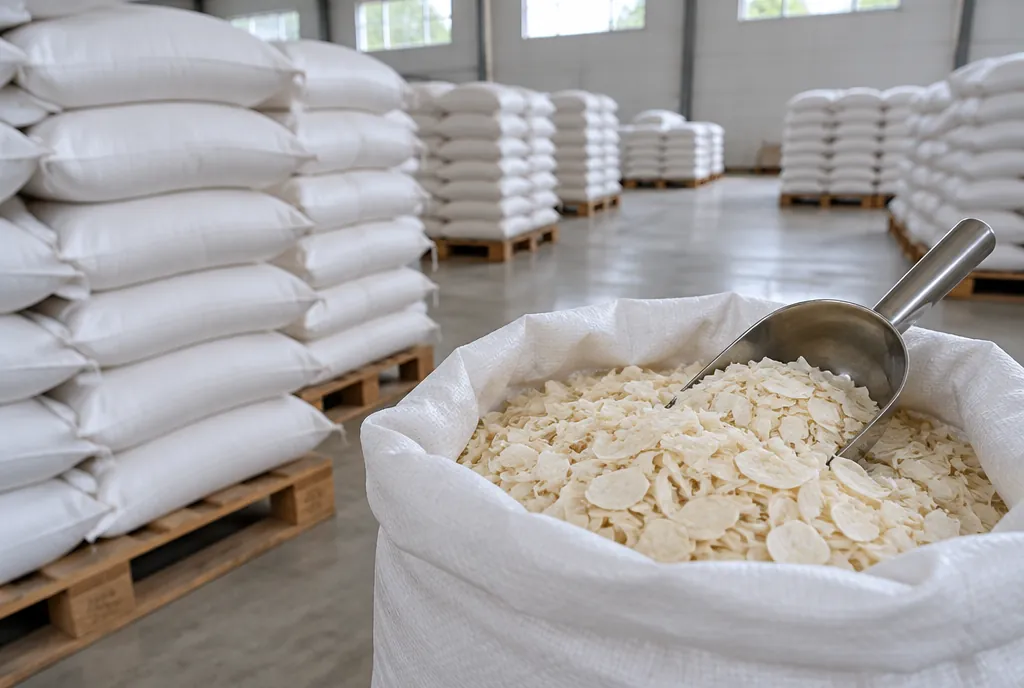
Here is what a published specification can look like. Poorti's potato flakes are listed as 100% through 1.7 mm, moisture 10.0% maximum, packed in 20 kg sacks, 480 sacks or 9,600 kg per 20 ft container, with 12 months' shelf life and HS code 1105.20 (potato flour is 1105.10). See the potato flakes and flour page. For onion, the guide to dehydrated onion grades explains how kibbled, chopped, minced, granules and powder differ, so you can name the grade you mean.
On the tariff code, the World Customs Organization explains that the Harmonized System identifies more than 5,000 commodity groups, each by a six-digit code, used by more than 200 countries and economies. The first six digits should match on the Indian shipping bill and your own entry. The digits after that are set nationally, so confirm your full national code with your customs broker.
Step 4: Approve a sealed sample
A specification describes the product in words. A sealed sample shows it. Ask the exporter to draw a sample from a real production lot, not a hand-picked batch, and to split it into identical portions. Each side keeps one portion sealed and dated. You test and approve yours.
That sealed sample becomes the reference for colour, aroma, cut size and appearance, and any dispute about the shipment is settled against it. Write into the contract that the bulk must match the approved sealed sample and the written specification, and say how long each side keeps its portion.
The sealed sample is the second of the six steps in Poorti's Make process: brief, sealed sample, brand and pack, produce, certificate of analysis for every lot, and dispatch. Nothing is produced until the sample is approved.
Step 5: Agree testing and a certificate for every lot
Testing shows the product meets your specification and gives you the evidence your regulator expects. Under the US rule, for example, sampling and testing are among the verification activities an FSVP importer may use. In Great Britain and the EU, the products that face extra border checks are listed against named hazards, so your tests should cover those hazards first.
Agree these points in writing before the first order:
- The parameters. List every test, with your limit for each: moisture, particle size, microbiology, and the chemical hazards your market targets for that product.
- The method. Name the test method for each parameter, so the Indian result and your own result can be compared.
- The laboratory. Agree which laboratory tests the lot, and ask that it be accredited for the methods used.
- The certificate of analysis. Ask for one certificate for every lot, carrying the lot number that also appears on the bags and the packing list.
- Retained samples. Ask the exporter to keep a retained sample of each lot for the full shelf life, so any later question can be tested again.
A certificate of analysis is only as good as its link to the goods. If the lot numbers on the certificate, the bags and the packing list do not agree, it tells you nothing about your container.

Step 6: Get the label right for the market of sale
Labelling rules belong to the country where the food is sold, not to India. FDA states that food offered for import into the United States must comply with FDA labelling rules, and labels must be in English, and that it routinely examines and samples imports for labelling compliance. The EU, the UK and other markets have their own mandatory particulars, allergen rules and language requirements.
For bulk ingredients, the shipping marks on each sack matter as much as any retail label: product name, lot number, net weight, dates and country of origin. For retail packs made in India under your brand, finish the label to your market's rules before printing. Poorti's guide to food label requirements sets out what a label generally has to carry, and the guide to private-label food manufacturing in India explains how a product is made and packed under your own brand. Poorti offers private-label and neutral packing.
Step 7: Choose a shipping term that fits the freight
The Incoterms rule in your contract decides who books the ship, who pays the freight and insurance, and at what point the risk of loss passes to you. Use the current Incoterms rules published by the International Chamber of Commerce and name the port.
- FOB (Free on Board). The seller clears the goods for export and loads them. The ICC explains that under FOB risk passes to the buyer once the goods are loaded onto the vessel at the named port. You book and pay the main freight.
- CFR, often written C&F (Cost and Freight). The seller pays freight to your destination port, but the ICC notes that risk still transfers when the goods are placed on board at the port of shipment, and the seller owes no insurance. Arrange your own cargo insurance.
- CIF (Cost, Insurance and Freight). As CFR, plus the seller must buy insurance for you. The ICC notes the seller may choose the limited Institute Cargo Clauses (C) cover unless the contract says otherwise, so state the cover you want if you need more.
- FCA (Free Carrier). The ICC states that FCA is the appropriate rule when goods are transported in containers, because a container is usually handed over at a terminal before it is loaded. If you use FOB for containers, agree in writing when the container counts as delivered.
Poorti ships FOB Mundra, CIF or C&F. Whichever term you pick, the contract should also say who files the advance notice, who pays for border inspection and who bears the cost of a refusal.
Step 8: Inspect before the container is sealed
Once the container is sealed and on the water, any problem becomes expensive to fix. A useful pre-shipment inspection checks:
- The count of bags or cartons against the packing list.
- Bag markings and lot numbers against the certificate of analysis.
- The condition of the packing: no torn bags, wet patches or pest activity.
- A sample drawn from several bags and compared with the approved sealed sample.
- The container: clean, dry and odour-free before loading.
- Photographs of the loading and the seal number, recorded against the bill of lading.
If you cannot travel to India, you can appoint someone to inspect on your behalf. Poorti's Verify door offers factory inspection for overseas buyers, so you can see how and where the food is made before you commit to a supplier.
Step 9: Check the document set before the ship sails
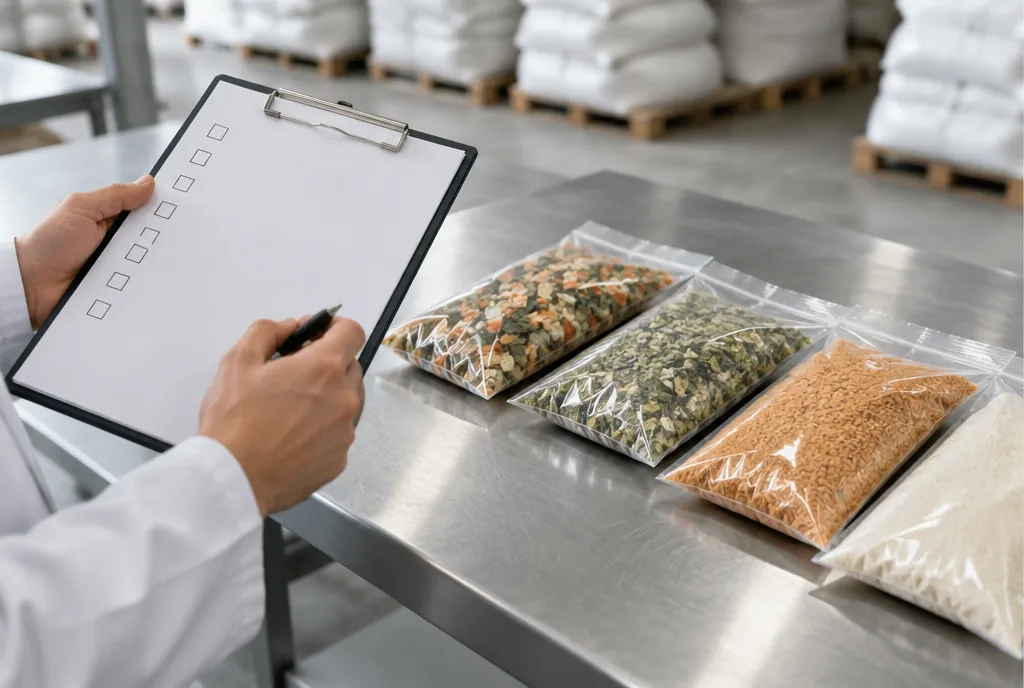
Ask for scans of every document before the originals are released, and read them against each other. Description, quantity, weights, lot numbers and tariff code should agree on every page.
| Document | Issued by | When you need it |
|---|---|---|
| Commercial invoice | Exporter | Every shipment |
| Packing list | Exporter | Every shipment |
| Bill of lading | Shipping line or its agent | Every sea shipment |
| Certificate of analysis | The testing laboratory | Every lot, as agreed in your contract |
| Certificate of origin | An authorised Indian body, such as the Export Inspection Council for preferential schemes | When you claim a lower duty rate, or your customs asks for proof of origin |
| Phytosanitary certificate | India's plant protection organisation, through PQMS | When your country requires one for that plant product |
| Health certificate | Export Inspection Council or the body your market recognises | When your market requires an official certificate for that product |
| Advance notice record | You, your broker or the exporter | FDA prior notice in the US, IPAFFS in Great Britain, a common health entry document in the EU for listed products |
Timing matters too. The EIC's executive instructions for honey, for example, state that a health certificate should be issued before or on the day of shipment and cannot be issued retrospectively, so leave nothing to the last day.
Why food shipments from India get held
Most holds come from a few avoidable causes.
- Incomplete or inaccurate entry data. FDA warns that submitting inaccurate or incomplete information may delay the review of your entry.
- No advance notice, or notice filed late. In the US, food without adequate prior notice is subject to refusal and is held at the port.
- A listed product sent to the wrong port. High-risk products in the EU or Great Britain must enter through a designated border control post.
- Documents that disagree. Different weights or lot numbers across the papers and the bags.
Each of these is fixed at the contract and specification stage, not at the port.
Questions people ask
What does an Indian exporter need before it can ship food to me?
At minimum, an Importer-Exporter Code from DGFT and an FSSAI licence. Exporters of APEDA scheduled products also hold an APEDA RCMC. Depending on the product and your market, the shipment may also need a certificate of origin, a phytosanitary certificate or a health certificate issued in India before it leaves.
Which shipping term should a first-time buyer use?
If you already have a freight forwarder who handles shipments from India, FOB or FCA gives you control of the freight. If you do not, CIF or CFR lets the exporter book the ship to your port. Under CFR you must insure the goods yourself, because the risk passes to you once they are on board in India.
Do dried vegetables from India need a phytosanitary certificate?
It depends on your country's rules for that product. India issues phytosanitary certificates based on the importing country's requirements, so check your own regulator first, for example BICON in Australia, then ask the exporter to apply through India's PQMS portal if a certificate is required.
Should every lot come with a certificate of analysis?
Yes, if you want the evidence to match the goods. Ask for one certificate per lot, carrying the same lot number as the bags and the packing list, and naming the test method for each parameter. Poorti's Make process includes a certificate of analysis for every lot.
Can an Indian exporter make food to my country's standards instead of India's?
FSSAI's licensing FAQ says manufacturers of food meant for export may follow the standards of the importing country, provided those products are not sold in India without prior approval. Put your country's limits into the written specification so they become part of the contract.
If you buy dehydrated onion, dehydrated garlic, dried ginger, potato flakes and flour, fire-roasted pulps or vegetable and fruit powders by the container, send Poorti the product, the specification you buy to and your destination port at poorti.net/contact. Browse the range through the Source door or start with the dehydrated onion range. If you are a brand founder who wants a product made under your own label, start at poorti.net/make.
Buying from India?
Send the product, the specification you buy to and the destination port, and the house will come back to you.
Send an enquiry