Potato Flakes Suppliers: How to Choose and Check One
Checked
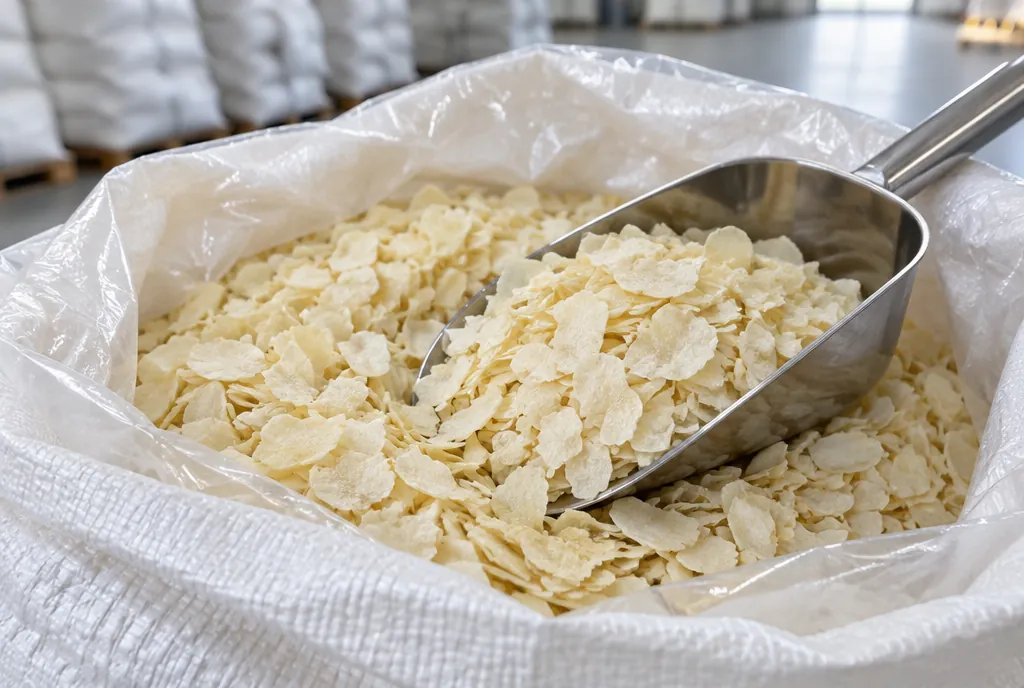
Choosing between potato flakes suppliers comes down to one document: a written specification that fixes particle size, moisture, sulphur dioxide, microbiology, packing and shelf life, and a supplier who confirms every lot against it. Start from what your line needs, ask each supplier to quote against the same specification, approve a sealed sample, and accept no container without a certificate of analysis for that lot. This guide shows what to put in that specification, which tests and documents matter, and how to plan a container from India.
What should you decide before you contact potato flakes suppliers?
Decide what the flakes have to do in your product. A buyer making instant mash needs flakes that rehydrate quickly to a smooth texture. A snack or pellet maker needs a consistent particle size so the dough sheets evenly. A coating or batter line usually wants something finer, which may mean potato flour rather than flakes. The application decides the specification, and the specification decides which supplier can run your order.
Write down four things before the first call:
- The product and cut. Flakes or flour, and the particle size or mesh your line runs on today.
- What you make with it. One line is enough. It tells a supplier which grade and which process settings matter to you.
- Volume and frequency. Tonnes per shipment and shipments per year. A supplier quoting one container is quoting a different job from one quoting twelve a year.
- The limits you cannot break. Moisture ceiling, sulphur dioxide limit, microbiological standard, any certification your customer demands, and the label language at destination.
With this on paper, every supplier quotes against the same request, and you can compare the answers line by line.
What decides the quality of potato flakes?
Potato flakes are cooked, mashed potato dried in a thin sheet and broken into flakes. The customs definition says the same: Japan Customs, classifying flakes under subheading 1105.20, quotes the Harmonized System explanatory note that these products may be made by steam-cooking and mashing fresh potatoes and drying the mash to thin sheets cut into small flakes (Japan Customs classification ruling). Quality is decided at six points along that process.
Potato solids and variety
The raw potato sets the ceiling on quality. Potatoes with high dry matter give more flake per tonne and dry more evenly. Potatoes with low reducing sugars brown less when heated. These are the traits Indian breeders select for in processing varieties: the Indian Council of Agricultural Research describes its processing variety Kufri Chipbharat-1 as having high dry matter of 21% and low reducing sugars (ICAR). Ask every supplier which varieties they process, what minimum solids they accept at intake, and what happens to a load that falls short. A supplier who turns away low-solid loads protects your consistency. One who blends them in passes the problem to you.
Cooking and drum drying
Flakes are made on steam-heated drum dryers. The mash is spread in a thin film on a rotating drum, dried, scraped off as a sheet and milled. The settings on the drum affect colour, flavour and how the flakes rehydrate. You will not see these settings, but you will see their result in the sample: colour, smell, and the texture of the mash when you make it up to your own recipe.
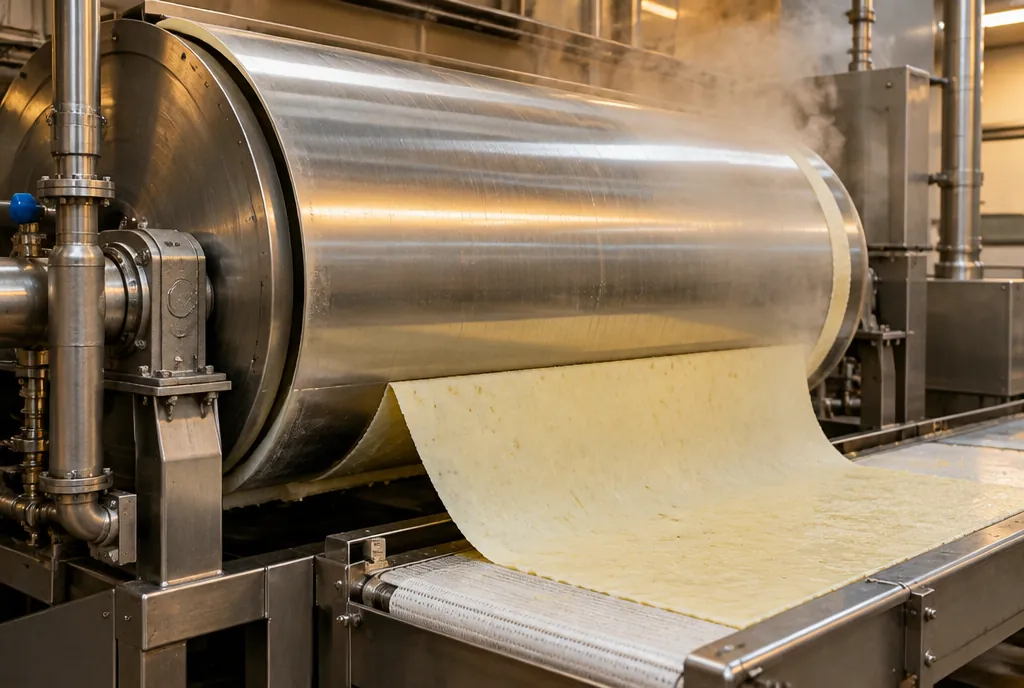
Ask whether the line can be set to your grade, or whether it runs one standard grade for everyone.
Particle size and bulk density
Particle size is written as a sieve result, for example "100% through 1.7 mm". That tells you nothing is larger than 1.7 mm. It does not tell you how much fine powder is in the sack, and fines change how the flakes hydrate and how they flow in your hoppers. Ask for a sieve distribution across three or four sieve sizes, not one pass figure. Ask for bulk density too. It decides how many kilograms fit in a sack and how much a container will hold before it is full by volume.
Moisture
Moisture decides shelf life. Flakes that leave the dryer too wet can cake, lose colour and grow mould in a warm container. Fix a maximum in the specification, state that it is measured by weight, and ask which method the supplier and its laboratory use, so your own test on arrival is comparable.
Sulphur dioxide
Many flake lines dose a sulphite into the mash to hold colour through drying and storage. It is measured in the finished flakes as sulphur dioxide, in parts per million. Your specification should state a maximum, and the certificate of analysis should report the measured value for each lot. If your customer needs flakes with no added sulphite, say so at the start, because it changes the process and the shelf life the supplier can offer.
Microbiology
Flakes are cooked, but they are handled after cooking: milled, sieved, packed. Contamination can enter at those steps. A specification normally sets limits for total plate count, coliforms, E. coli and Salmonella, and often yeasts and moulds. Ask which method the laboratory uses for each. Standard reference methods exist, such as ISO 4833-1 for counting micro-organisms by the plate count technique (ISO) and ISO 6579-1 for detecting Salmonella (ISO).
Do you need flakes, granules or potato flour?
All three start from cooked potato, but they are dried and milled differently and do different jobs. Customs treats them separately too: flakes, granules and pellets share subheading 1105.20, and flour, meal and powder of potatoes fall under 1105.10 (USITC Harmonized Tariff Schedule). Potato starch is a different product again, classified under 1108.13. Our guide to potato starch, potato flour, flakes and granules sets out the differences in full.
| Product | What it is | Typical uses | HS subheading |
|---|---|---|---|
| Potato flakes | Cooked mash drum-dried to a thin sheet and broken into flakes | Instant mash, snack pellets, croquettes, dumplings, ready meals | 1105.20 |
| Potato granules | The same cooked base, dried in a different dryer to small, dense, free-flowing particles | Lines already set up for granules; check water and mixing time before switching to flakes | 1105.20 |
| Cooked potato flour | Cooked, drum-dried potato milled finer than flakes | Binding in patties and cutlets, coating and batter systems, bakery texture, thickening | 1105.10 |
| Potato starch | Starch alone, washed out of raw potato with protein and fibre removed | Thickening; it does not rehydrate to mash | 1108.13 |
If you need a binder, ask for cooked potato flour by name. Raw potato flour is a different material that still needs cooking.
What does a full potato flakes specification look like?
A full specification covers the physical and chemical limits, the microbiological limits, packing, loading and shelf life. As a worked example, here is the specification Poorti Mandalam LLP publishes for its potato flakes and flour. Use it as a model, then set each value to what your process needs.
| Parameter | Published value | What to ask any supplier |
|---|---|---|
| Particle size | 100% through 1.7 mm (1680 micron) | Full sieve distribution, including fines |
| Moisture | 10.0% max by weight | Test method, and the result on each lot's certificate |
| Sulphur dioxide | 180 ppm max | Measured value per lot, and the test method |
| Microbiology | Limits set out in the published dossier | Limit and method for each organism |
| Primary pack | 20 kg net sacks | Sack type, liner, and lot marking |
| Loading, 20 ft container | 480 sacks, 9,600 kg net | Loading plan, palletised or floor-loaded |
| Shelf life | 12 months from date of manufacture, in sealed pack | Storage conditions the shelf life assumes |
| HS code | 1105.20 flakes, 1105.10 flour | The code the supplier will declare |
The full document, with microbiological limits, the flake grades and what each is for, dose rates by application, packing, container loading and the paperwork that moves with the container, is in the potato flakes and flour specification dossier (PDF). Read it alongside any other supplier's sheet. Where the other sheet is silent on a line, that is the question to ask.
When you read any specification, ask whether each number is a maximum or a typical value. A typical range describes an average lot. A maximum is a ceiling you can reject a lot against. The result for your lot is on its certificate of analysis.
How does sulphur dioxide affect your label?
Many markets require sulphites to be declared on the label, and the trigger level is low. Here is how two large import markets set it.
- United States. Under 21 CFR 101.100(a)(4), a sulfiting agent with no technical effect in the finished food is treated as insignificant only if no detectable amount is present, and a detectable amount is 10 parts per million or more in the finished food (21 CFR 101.100, Cornell Legal Information Institute).
- European Union. The Food Safety Authority of Ireland explains that for prepacked foods, sulphur dioxide and sulphites must be declared on the label by their full name where the level exceeds 10 mg/kg or 10 mg/L, expressed as SO2, and that the E number alone is not enough (FSAI).
Since 10 mg/kg and 10 ppm are the same amount, flakes at a specification limit such as 180 ppm sit far above both thresholds when sold as they are. If you use the flakes as one ingredient in a recipe, the amount carried into your finished food depends on your inclusion rate and on what your process does to sulphite. Ask your own laboratory to test the finished product before you settle the label. Do not assume that a dilution calculation will hold.
The maximum sulphur dioxide permitted in dehydrated potato products differs between markets. Check the limit with the regulator in your destination market, write it into your specification, and make sure the certificate of analysis reports a measured value, not "complies".
How should sample approval work?
A sample is only useful if the container matches it.
- Ask for a sample from current production. A sample from the office cupboard shows what the supplier made once.
- Ask for the certificate of analysis for the sample's lot. Test the sample yourself or through your laboratory, and compare your figures with the certificate.
- Run it on your line. Make up the mash, the dough or the coating to your own recipe. Note water uptake, mixing time, colour and texture.
- Seal the approved sample. Keep a sealed, labelled portion as the reference standard, and make sure the supplier keeps one from the same lot. Any dispute goes back to that reference.
- Write the approval into the order. The purchase contract should name the specification, the sealed sample reference and the tolerance on each parameter.
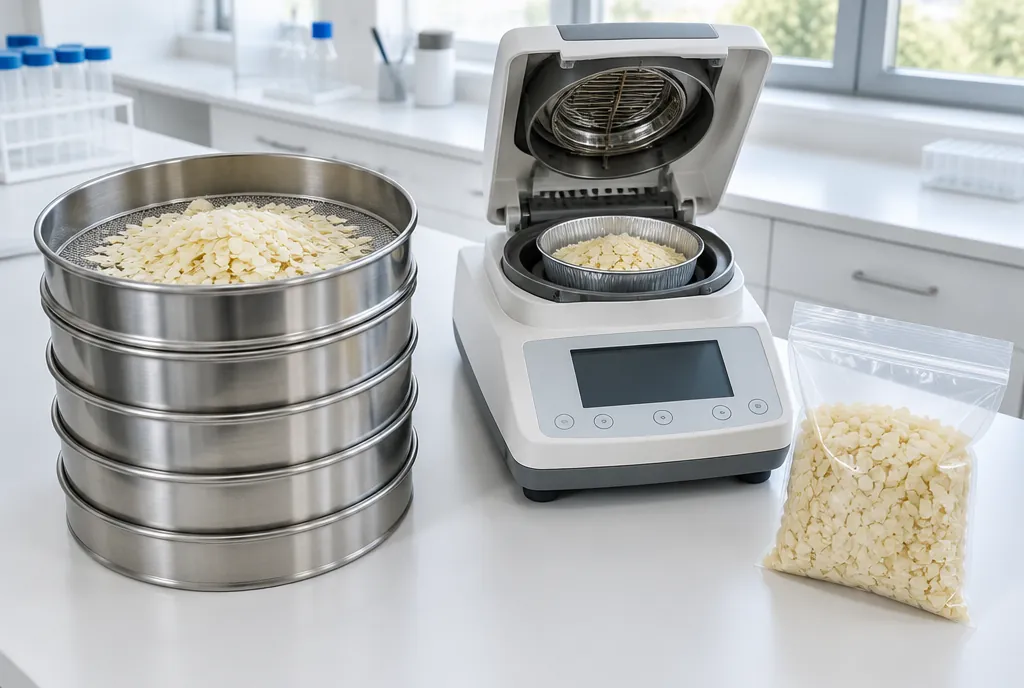
When the first container arrives, draw your own samples from several sacks across the load and test them against the specification and the sealed reference. A first container that passes tells you more about a supplier than any sample.
Which documents should travel with each lot?
Agree the document list before you order. It depends on your destination, but most shipments need the following.
- Certificate of analysis for each lot. Measured values for every parameter in your specification, with the lot number, the production date and the laboratory that did the work.
- Commercial invoice and packing list. The packing list should show lot numbers, the number of sacks per lot and net and gross weights.
- Bill of lading. Issued by the shipping line once the container is loaded.
- Certificate of origin. Needed to claim any preferential duty your country offers on goods from India.
- Any certificate your market or customer requires. A health certificate, a halal or kosher certificate, or a food safety certification. Ask for a copy in advance and check it is current and issued to the company that will invoice you.
Your own import formalities run in parallel. For the United States, for example, food imports need prior notice filed with the Food and Drug Administration before arrival (FDA guidance on prior notice). Settle the full list with your customs broker before the container is booked.
Each sack should carry a lot number and a production or best-before date that match the certificate. If the sacks are neutral or private-label, agree the marking in writing before production.
How do you plan a container of potato flakes?
Potato flakes are light for their volume, so a container fills up by space before it reaches its weight limit. On Poorti's published specification, a 20 ft container holds 480 sacks of 20 kg, which is 9,600 kg net. Another supplier's figure may differ, because sack size, flake grade and bulk density all change it. Ask each supplier for a loading figure in writing for your grade. If you want a 40 ft container, ask for its loading figure separately rather than doubling the 20 ft number.
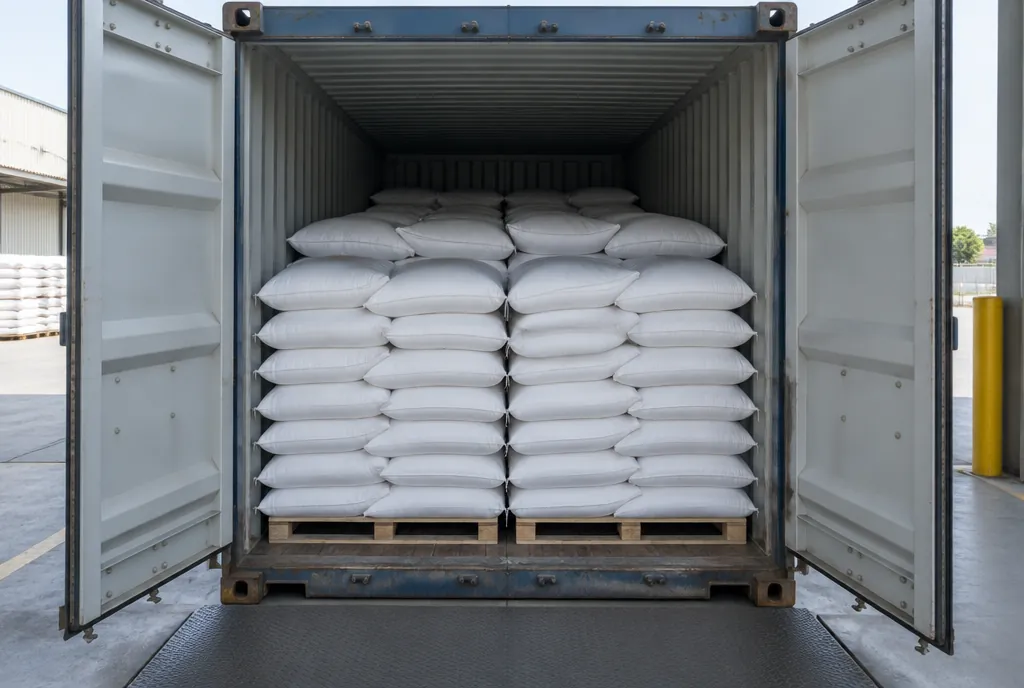
Agree the delivery term. The Incoterms rules published by the International Chamber of Commerce define who pays for and carries the risk on each leg of the journey; the current edition is Incoterms 2020 (ICC). The three terms most often used for Indian food ingredients are:
- FOB, with the port named, for example FOB Mundra. The seller loads the goods on board at the Indian port. You arrange and pay for the sea freight and insurance.
- CFR, often written C&F. The seller pays freight to your port. Risk passes to you when the goods are on board in India.
- CIF. As CFR, plus the seller buys insurance for the voyage.
Plan the timing too. Flakes have a fixed shelf life from the date of manufacture, so the clock starts at the plant, not at your warehouse. If you buy several containers a year, ask for production dates close to each shipment. Store the sacks cool and dry, away from sunlight and strong smells, and rotate stock by production date.
What are the warning signs when comparing suppliers?
Most problems show up before the first container, if you look for them.
- A specification with only typical values. No maximums, no methods, no microbiology. You will have nothing to reject a lot against.
- "Complies" instead of numbers. A certificate that says "complies" for sulphur dioxide or moisture is not a measurement.
- A loading figure that does not add up. If the stated sacks per container and sack weight do not match the stated net weight, ask why before you order.
- Certificates in a different name. A food safety or export licence issued to one company, with invoices from another. Ask who makes the product, who packs it and who will invoice you.
- No questions back. A supplier who does not ask what you make with the flakes is quoting a standard grade, whatever your line needs.
If you cannot travel to India, an inspection of the maker before you commit is the most direct way to check these points. An inspection records what was seen on a stated date. It does not replace the certificate of analysis or your own arrival testing.
A checklist for comparing potato flakes suppliers
Send the same request to each supplier and score the answers against this list.
- Product and grade named: flakes, granules or cooked potato flour.
- Particle size given as a sieve distribution, including fines.
- Moisture maximum stated, by weight, with the test method.
- Sulphur dioxide maximum stated, with measured values on each certificate.
- Microbiological limits for total plate count, coliforms, E. coli, Salmonella, yeasts and moulds, with methods.
- Varieties processed and minimum solids accepted at intake.
- Sample drawn from current production, with the certificate for its lot.
- Sealed reference sample held by both sides.
- Sack type, liner, net weight and lot marking agreed.
- Sacks and net kilograms per 20 ft container, in writing for your grade.
- Shelf life stated from date of manufacture, with storage conditions.
- HS code the supplier will declare.
- Delivery term agreed: FOB with the port named, CFR or CIF.
- Full document list agreed with your customs broker before booking.
- Any certificate your market requires, checked as current and in the invoicing company's name.
- Your own test plan for the first container on arrival.
How does Poorti handle a potato flakes enquiry?
Poorti is a food house in Ahmedabad. It does not own a plant. It works through a circle of farmers, processors, manufacturers, testing laboratories and logistics partners across India, and holds them to one standard. For a buyer, the house does the supplier work described in this guide.
- Sourcing through the circle. Through its Source door, Poorti matches your written specification to a maker in its circle that can produce it, and ships by the container FOB Mundra, CIF or C&F, in private-label or neutral packing.
- A published specification. The potato flakes and flour specification, including the values in the table above, is published in full, so you can compare it with any other sheet.
- A sealed sample and a certificate for every lot. Production runs to the approved sealed sample, and every lot ships with a certificate of analysis.
- Inspection before you commit. If you are sourcing elsewhere in India and want the maker checked, Poorti's factory inspection visits shortlisted makers in person on a stated date, against the same eight checks every time, and writes a report with dated photographs and samples drawn from live production.
Questions people ask
What should I send potato flakes suppliers in my first enquiry?
Send the product and grade, the particle size you buy to, what you make with it, tonnes per shipment and shipments per year, the destination port, the delivery term you want, and every limit you must not break, such as moisture, sulphur dioxide and microbiology.
What is the HS code for potato flakes?
Potato flakes, granules and pellets are classified under subheading 1105.20. Potato flour, meal and powder fall under 1105.10, and potato starch under 1108.13 (USITC). National tariff lines add further digits, so confirm the full code with your customs broker.
Do potato flakes contain sulphites?
Many do, because a sulphite is often dosed into the mash to hold colour. Ask for the specification maximum and the measured value on each lot's certificate. In the United States and the European Union, 10 mg/kg (10 ppm) in the food is the level above which sulphites must generally be declared (21 CFR 101.100; FSAI), so test your finished product before you settle the label.
How many sacks of potato flakes fit in a 20 ft container?
It depends on sack size and bulk density. On Poorti's published specification, a 20 ft container holds 480 sacks of 20 kg, or 9,600 kg net. Ask every supplier for its own figure for your grade, in writing.
What shelf life should I expect from potato flakes?
Poorti's published specification gives 12 months from the date of manufacture, in sealed pack, stored cool and dry. Whatever the figure, check that it runs from the date of manufacture.
Is a certificate of analysis enough to accept a container?
It is the starting point. Compare it with your specification and the sealed reference sample, and test samples drawn from several sacks when the container arrives. Over time, your arrival results tell you whether the supplier's certificates can be relied on.
If you are buying potato flakes or potato flour by the container, send Poorti the product, the specification you buy to and your destination port at poorti.net/contact. If you are a brand founder who wants a potato product made under your own label, start at poorti.net/make.
Buying from India?
Send the product, the specification you buy to and the destination port, and the house will come back to you.
Send an enquiry